 ← Blog
The Rise of the
Autonomous Hotel

Mahesh Kumar Gupta
Head of AI & ML

with Swabhinav Sinha
Founder
01Jaipur, near midnightContents ▾
Jaipur, near midnight
In June the five of us drove back into Jaipur from Khatu Shyam Ji — my wife, my parents, my brother and me. It is a couple of hours on the road. We had not planned to stop for the night, but we stopped for dinner at a thali place on Sarojini Marg, and by the time we were done it was nearly midnight. We ended up at a small hotel near Chandpole Bazaar, inside the old Pink City, and walked up to the desk.
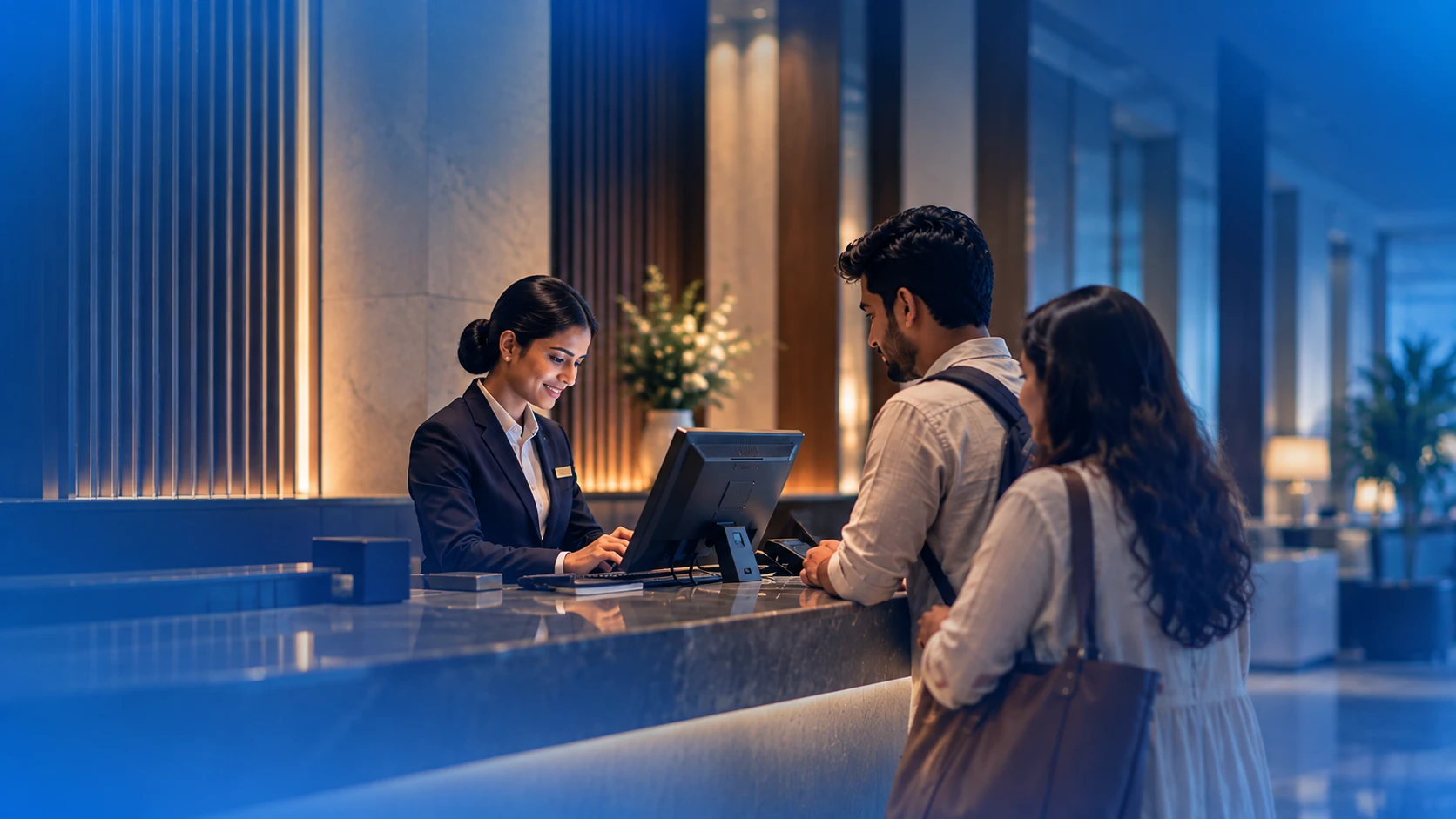
The manager was there himself, a man of about forty. I stood and watched him check us in, and it took more than four minutes. Not because he was slow — he knew the software — but because every part of it was manual. He filled in the booking form field by field. He went through the rooms and compared them himself to find the best one. He took our ID cards, scanned them, and attached each scan to the record by hand. Nothing was filled in for him. Nothing was suggested.
We had agreed the actual booking — room, rate, two nights — in about a minute of talking.
The typing took four times as long as the decision did.
Chandpole Bazaar, 11:30 PM
Three or four other families were waiting behind us. It was half past eleven, and he was doing his best, but you could see the software was in his way.
We got talking and I told him what we do — we build AI for hotels, a butler app that sits with the guest and the system that runs the property behind it — and that we had an offer running for new properties. A little later he moved us into a better room at the same rate. He read the situation and made the call in a couple of seconds. No screen involved in that one.
That last part is the whole point of this piece. The four minutes of manual entry added nothing to my stay. The upgrade did. And his night was built so that the data entry was the main event and the judgment had to happen in the gaps.
It was a good hotel. Clean, well run, the kind of place that knows what it is doing. The software was the weakest thing in it, and not by a little.
It is not one hotel
Every hotel runs on a property management system. Different names on the box, same thing underneath: a place to record what is going on. Who is arriving, which rooms are clean, tonight's rate, who owes money. For that, they are fine.
The trouble starts when something has to move between those records. A guest asks for a late checkout. That room is needed for an arrival. Housekeeping has to reshuffle. Maybe the arrival ends up in a different room instead. Four systems each hold a piece of that, and none of them hold the whole thing, so a person keeps it straight in their head and then updates each screen by hand. Do that a few hundred times a day, because that is roughly what a front desk does between morning and night.
Why the PMS in particular cannot close that gap is a longer argument, and it is the next piece in this series. Here I only want to establish that the gap is real, and that people are the ones standing in it.
Automation got halfway
Hotels already automate the easy parts. Occupancy over 80 percent, push the rate up. Booking confirmed, send the welcome message. Room flipped to dirty, ping housekeeping. Useful, and most places run some version of it.
But a rule does not look up from the rule. It does not know that tonight's 80 percent is one big wedding group that will walk if you touch the price. It does not know housekeeping is already an hour deep and your alert is just noise. The rule fires the same way every time, and when two rules disagree, a human has to step in and settle it. That is where automation has been stuck for years.
What actually changed
People have said “AI is going to change hospitality” for a decade, and mostly they meant a chatbot that answers where the pool is. That is not what I am talking about.
What is different now, and it is recent — the last two years or so — is that a model can take a sloppy instruction in plain words, work out what you meant, and then carry it out in the software. Not write a paragraph about carrying it out. Call the function, put in the right values, check that it worked.
Give it something like “shift the family in 214 to a quieter room for their last night.” It finds the booking, checks what is free in that room type for that date, picks one, makes the change. The same steps the front desk person would take, without the four minutes.
A rule follows an instruction somebody wrote in advance. This handles a situation nobody wrote down, and it stays inside limits you set. That is the difference between automation and autonomy, and hotel software is only now able to cross that line, because the model can hold the context, the data is reachable, and there is finally a safe way to let software act instead of only read.
What an autonomous hotel means
Not a hotel with no staff. A hotel where the small, endless operational decisions get handled by software, and the people spend their time on the parts that need a person.
So the system watches the whole property at once. A flight runs late and it holds the room. Housekeeping falls behind and it reorders the list around who is actually arriving first. A concert goes on sale nearby, demand jumps, and it flags a rate change within the rules the hotel already set. A guest messages at 2am and it answers. Something odd happens and it hands that one to a human, instead of burying them in the fifty that are not odd.
The staff move up a level. Less typing, fewer tiny calls, more attention on the guest in front of them and the cases that actually need judgment. The upgrade in Jaipur should always be a person. The data entry wrapped around it should not be.
None of this works without a firm line on what the software may do by itself. Anything that really matters — money, a confirmed booking, a rate change across a range of dates — stops and waits for a person to approve it, every time. Not because the model decided it was unsure, but because that is how the thing is built. Autonomy only makes sense with a boundary drawn around it.
Where this goes
My guess is that within a few years, the first thing you learn at a front desk job stops being “our system.” You just talk to it. The training goes toward the actual work — a difficult guest, when it is alright to bend a policy, getting a coach tour checked in without a queue forming.
And the hotels that pick this up early will not talk about it as an AI thing. They will say they are running three properties with the effort one used to take, or that the night manager gets to go home on time now. The technology will not be the story. The few hundred decisions that quietly left the day will be.
Every big shift in hotel software has moved work off people and into the system. Spreadsheets did it. The PMS did it. Channel managers and revenue tools, same pattern. The next one is not another screen to keep open. It is software that watches the whole hotel, thinks about what it sees, and acts — so the people can go back to doing hospitality.
That has started already. The hotel in Jaipur will get there late, not early. But it will get there.
Written by
Mahesh Kumar Gupta, Head of AI & ML, with Swabhinav Sinha, Founder
Get in touch
Let's put your hotel on autopilot.
Tell us about your property and we'll show you exactly what BluEarn would change, with your own numbers.